|
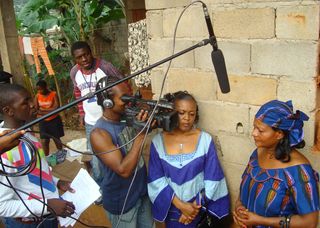 No film industry can stand tall and proud if the production of documentary films leaves much to be desired. This assertion fits Africa so squarely. Reason – the continent is such a fertile ground for happenings. Further, Africa’s rich cultural heritage and natural endowment provide a huge reservoir for stories that can endlessly feed the ever-growing film audience worldwide. Perhaps, the need to tell stories that are deliberately ignored by the West is the main reason to have a vibrant documentary film sector. Exhibiting documentary films to that effect may just be an appropriate way of encouraging many more producers to tell the African tale the right way. Credit for this goes to the AfricaWorld Documentary Film Festival, an annual event which kicked off last year and was co-hosted by the Department of African and African-American studies, University of Missouri, St Louis, USA and the Department of Performing Arts and Cinematography of the University of Yaounde I. Ahead of the second edition of the festival, Ernest Kanjo caught up with the person who brought the event to Cameroon. Dr Tangem Donatus Fai (permit Donatus Fai Tangem, DFT) spoke on the line Yaounde. Excerpts of the chat with the UNIYAO l lecturer and drama specialist! No film industry can stand tall and proud if the production of documentary films leaves much to be desired. This assertion fits Africa so squarely. Reason – the continent is such a fertile ground for happenings. Further, Africa’s rich cultural heritage and natural endowment provide a huge reservoir for stories that can endlessly feed the ever-growing film audience worldwide. Perhaps, the need to tell stories that are deliberately ignored by the West is the main reason to have a vibrant documentary film sector. Exhibiting documentary films to that effect may just be an appropriate way of encouraging many more producers to tell the African tale the right way. Credit for this goes to the AfricaWorld Documentary Film Festival, an annual event which kicked off last year and was co-hosted by the Department of African and African-American studies, University of Missouri, St Louis, USA and the Department of Performing Arts and Cinematography of the University of Yaounde I. Ahead of the second edition of the festival, Ernest Kanjo caught up with the person who brought the event to Cameroon. Dr Tangem Donatus Fai (permit Donatus Fai Tangem, DFT) spoke on the line Yaounde. Excerpts of the chat with the UNIYAO l lecturer and drama specialist!
Ernest Kanjo (EK) : Could you remind us what the AfricaWorld Documentary Film Festival AWDFF is all about?Donatus Fai Tangem (DFT): AfricaWorld Documentary Film Festival, call it AWDFF is an initiative of the Department of African and African-American studies, University of Missouri, St Louis, USA. It focuses on the stories of and about Africa and or Africans, with the objective of presenting the other side of a continent and a people often projected essentially from a very negative perspective by the western media. Far from idealizing Africa, the film festival is about allowing Africans to tell their own stories, good or bad.
EK: How did Cameroon get involved in the festival?
DFT: That is a very good question. That Cameroon is today a co-host of AWDFF did not just happen by chance. In fact, it’s fallout of contacts and useful networking between two people who happen to be united by their passion, both in their jobs and for Africa. In 2010, I was invited for an international conference organized by the Centre for the promotion of Black Arts and Culture CBAC in Abuja, Nigeria. While there, I ran into Niyi Coker, an African-American professor and film maker who was also attending the same conference. In the course of our discussions, Niyi told me about a project he was working on and was interested in meeting and talking with pygmies, preferring to meet them in their natural environment. Once I reassured him that we had pygmies in Cameroon, he immediately made plans to visit Cameroon and possibly shoot part of the documentary he was working on. That’s how he eventually visited Cameroon for the first time in late 2010. On this visit, we also discussed the AWDFF of which he is a very influential member of the organizing commission. Once I announced this to my Head of Department, Professor Bole Butake, he jumped to the idea. Together, we all consulted the Dean, Professor Omgba who equally threw his weight behind the initiative and so Cameroon, and more specifically, the University of Yaounde I, Performing Arts and Cinematography section became a co-host of AWDFF 2011 edition.
EK: What does AWDFF bring in terms of development in the film sector?
DFT: This initiative brings so much. First, it enables Cameroonians to share in the stories of the rest of Africa and Africans around the world. More specifically, it enables Cameroonian film makers to tell and share their own stories to the world. I must tell you that every film festival constitute a golden opening for practitioners to get together and measure the depth of their contribution to the sector. Above all else, the festival may be an opening for Cameroonian cinema to see where it stands and the position it occupies on the global scale. Possibilities of training workshops and debate can develop on the sidelines of film projection.
EK: How would you assess the maiden edition that took place last year?
DFT: I’d say the first edition was the experimental phase which caught most students and film makers off guard. A lot of film makers got to know about the festival only towards the end. This was also due to the fact that in our anxiety to host the festival, we did not take sufficient time to consult the university programme, hence the festival was scheduled to coincide with the Easter break during which time most students and staff were out of town. However, the first edition was a wake-up call.
EK: What are the lessons to be learnt?
DFT: A lot of lessons! Lessons about how much we stand to gain by telling our stories, lessons about what we stand to benefit when we harness our art and culture.
EK: How different will the second edition be from the first?
DFT: Hopefully, we will have documentary films by Cameroonians resident at home this time. We also hope to correct organizational errors we had in the previous edition such as double checking with timing in respect of the university programme.
EK: How is Cameroon preparing?
DFT: We are doing our best with the means at our disposal. You know, even though we are in the second edition we are still at the starting line. But we are not taking chances. Personally, I consulted many film makers and launched a call for submission. But many people approached me with fictional films, which were not of course acceptable.
EK: What does Cameroon have to show this time?
DFT: Well, I cannot say at this time. I have simply submitted the few that I collected and I hope they’ll arrive in time for the commission to access.
EK: How do film makers register for the festival?
DFT: There is no registration as such. I simply launched an open call for submission and for participation. Even film makers who did not or could not submit any films are welcome to attend and partake in the discussions and debate. That way they will share and gain knowledge in the art of documentary film making.
EK: Apart from projecting documentaries, do you have other side activities?
DFT: I would say the major item as at now is the film projection and the interactive exchanges that will follow and of course we will have film display and exposition. This is also a moment to see what other film activities may be going on and get to know who is doing what and how.
EK: Generally, how would you rate Cameroon in documentary production?
DFT: I think Cameroonians are doing quite a great job in documentary film production. I found out that there are a lot of documentaries that have not been properly projected and exploited. At CRTV for example, I discovered tons of documentaries produced by Margaret Fombe under the broad title.
EK: What can be done to encourage the production of documentaries in Cameroon?
DFT: Cameroonians are already doing a good job. I think the various film makers have to devise means by which such products can be widely distributed. It’s not useful to spend time and money on a product that does not reach consumers.
EK: After AWDFF 2012, where do you intend to carry Cameroon to in terms of documentary films?
DFT: I intend to further make Cameroonians evaluate themselves and decide where they want to be placed on the global rating, this is the challenge I’ll like film makers to face.
EK: Any last appeal?
DFT: My appeal would that film makers should take off time and witness what other people are doing and also begin to move away from the greedy spirit with which they operate. You see, during this period that I launched the call, I also made personal phone calls to some film makers and expected them to circulate information around but out of greed, some of them simply packaged their own films and sent and never bothered to inform other colleagues. Also, I found out with much regret that most film makers were either not ready or able to cover the cost of expediting their films to the selection commission in the USA. That was simply disgraceful.
EK: It was wonderful talking with you. Thanks a lot.
DFT: The pleasure was mine Ernest. Thanks for always being there for the film industry in Cameroon
|
